
Comfort Measures Only
Sometimes that is enough.
 Pulling back on the
plunger, I watch as
the liquid morphine
fills the barrel of the
syringe. In a room
down the hall lies one of my
patients who has been diagnosed
with end-stage ovarian cancer,
and it's my job to ensure that
she remains relatively comfortable.
Entering her room, I immediately
notice the worried looks
that blanket the faces of her
somber family members. It's at
this time that I am reminded
that I once experienced a scene
very similar to this, but on that
day, I was the grieving family
member and it was another who
played the role of caregiver.
Pulling back on the
plunger, I watch as
the liquid morphine
fills the barrel of the
syringe. In a room
down the hall lies one of my
patients who has been diagnosed
with end-stage ovarian cancer,
and it's my job to ensure that
she remains relatively comfortable.
Entering her room, I immediately
notice the worried looks
that blanket the faces of her
somber family members. It's at
this time that I am reminded
that I once experienced a scene
very similar to this, but on that
day, I was the grieving family
member and it was another who
played the role of caregiver.
How quickly and efficiently that busy nurse moved as she handled my father's fragile, precious body. Although she was very gentle and at all times professional, her emotionally detached demeanor upset me. Her expression remained flat as she scurried about the room attending to his medical needs, and it seemed to me that she saw him as a task to complete rather than the person he was. He was my father and my friend, and it saddened me to think that she would never know him as anything but the piece of flesh that lay dormant and decaying on the bed in front of her.
A soft moan escapes my patient's lips, bringing me back to the present. After giving her another dose of morphine to relieve the pain, I gently clean and reposition her, making sure that I take the time to swab out her parched, dry mouth. She is a person to me, a human being who has loved and been loved, and it brings me a feeling of satisfaction to be able to ease her suffering in her final hours. I gently express these sentiments to her grieving loved ones and smile reassuringly as I go about the labor of my chosen profession.
We buried my father on a cool, clear October afternoon, when the colored leaves were falling from the trees, and all of nature was preparing for a long sleep. He had experienced no pain and had drifted peacefully into death. I never spoke with that nurse who took care of him during his last days, but I've often wondered what went through her mind as she mechanically completed her assigned nursing duties. This family will not wonder, for if I do my job properly, this will be a dignified, pain-free death, and they will know that I truly do care.
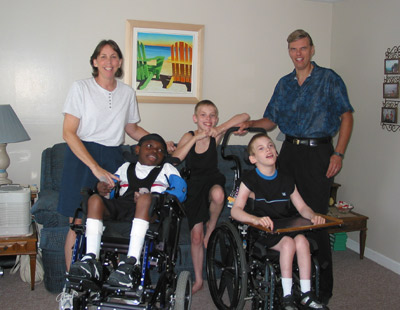
Photograph Caption: The Bissell family, from left: Cindy, Anthony (in wheelchair), Aaron (standing), Eric (in wheelchair), and Richard, who became a nurse in 1990, soon after his father died. He began his career working in geriatrics providing care for individuals with end-stage Alzheimer disease. In 1993, after the premature birth of his twin sons, both of whom have developmental disabilities, Bissell became an advocate for people with mental retardation. In 2001 he received the Massachusetts Governor's Citation for extraordinary and exemplary efforts on behalf of people with mental retardation.
About the Author: Richard C. Bissell cares for developmentally disabled adults at the Commonwealth of Massachusetts Department of Mental Retardation at the Glavin Regional Center in Shrewsbury, MA. Contact author: rich@bissells.com.
AJN - February 2005 - Vol. 105, No. 2
