FATHERS' VOICES
Two Precious Gifts
Trading old dreams for new ones.
by Richard Bissell
I had just taken a bite of my turkey sandwich when my wife, Cindy, came in the front door. I could tell she was fighting back tears. "It's Eric," she blurted out and broke down.
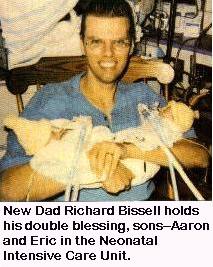
We had premature twin babies in the Neonatal Intensive Care Unit (NICU). Born after only 26 weeks, they weighed a mere two pounds each. They had been in the hospital for close to six weeks, fighting for their lives.
I waited for Cindy to calm down enough to tell me what was happening. I needed to know, but at the same time I was afraid to hear. My mind reeled as she gave me an explanation I couldn't really comprehend. I felt as if the breath had been knocked out of me. There was a tightness in my stomach and chest. The official diagnosis was periventricular leukomalasia with intracranial hemorrhages. I felt trapped by the words-fancy words for the type of brain damage that leads to cerebral palsy. It was all so hard to believe.
"It's all right," I began. It was hard to move my mouth. "It will be all right. We will work it out."
Working it out
We had been splitting shifts at the NICU. Cindy stayed during the day; I did the night shift. We are both nurses at the same health care facility. Our employer had been very understanding, working out our schedules to give us as much time as possible with our babies.
Robotically, I made my way to the NICU. It was 11:00 PM. The hospital was quiet and the lights were dim. Glancing at the babies in the "Growing Preemie" section, I wondered if my sons would ever graduate to this haven where stable infants wait to go home.
The NICU was busy, as usual. Doctors and nurses walked briskly between incubators, checking IVs and respirators, turning off alarms and discussing treatments with one another in hushed voices. I greeted some familiar nurses and walked into the room our boys shared with 10 other incubators. All the fragile infants were enclosed in their plastic "houses" with each baby's name on the side.
Our boys had a multitude of problems, mostly related to prematurity. Very susceptible to infection, their bodies could not regulate their own temperatures. They could not be handled much because of raw, immature nervous systems. Some days all we could do was reach in through holes in the incubator sides and lightly touch their heads. On good days, we could hold them very gently for five or 10 minutes-very difficult conditions for normal parent/child bonding.
I sat down next to Eric's incubator and peeked in. A tiny bundle, he was sleeping peacefully, breathing on his own now with a nasal cannula taped to his nose for extra oxygen. He was hooked up to monitors to alert the nurses if he stopped breathing or if his heart rate dropped, both of which happened many times a day. The nurses would rush over and calmly shake him, a little "reminder to breathe." It had taken us a while to accept this routine.
I stuck my hand through the porthole of Eric's incubator and lightly touched his head. He stirred slightly, then went back to sleep. As I sat there, I thought of the necrosis (tissue death) and bleeding in his tiny brain. I walked over to Aaron's incubator, located right next to Eric's. Still on a respirator, he was too weak and fragile to breathe on his own. Looking at my sons, I had many mixed emotions: anger that they were not healthy and strong; fear and sadness because they were so sick, fragile and vulnerable. Mostly, however, I felt an intense love and desire to protect them from harm.
It was so difficult to stand by as they were bombarded by constant prodding and probing required for a multitude of medical procedures. Their tiny heels were black and blue from multiple blood tests. IVs were repeatedly stuck in their little arms. Even eating was an unpleasant task: Tubes stuck down their throats allowed Cindy's breast milk to be poured into their stomachs.
Patterns of crisis
We seemed to get into a pattern of good and bad days. Usually every few days brought a crisis with one baby or the other. Two steps forward, one step back; sometimes the other way around.
Aaron's most difficult time came when he was taken off the respirator. It was so hard to watch him struggle for every breath, his little eyes wide with fear. His windpipe was inflamed and scarred by the respirator that had saved his life. Eventually, we decided to take him to see a throat specialist for an evaluation and possible tracheostomy. Leaving Eric at the "home base" hospital with relatives, we followed the ambulance to another hospital. We met with the surgeon, then helplessly watched as Aaron was transported into surgery. Each passing minute seemed slower and more frightening than the last as we waited-keeping in constant touch with "home base." Finally the surgeon called us, "We had to do a tracheostomy, but he did just fine. You can see him when he's out of recovery."
It was then that we realized how strong Aaron is. He has a tremendous will to survive. After the surgery, seeing him with a tracheostomy was upsetting, but, at the same time, we were relieved that he looked so comfortable. He was at ease for the first time in weeks, neither having a tube down his throat nor having to struggle to breathe. With both boys so unstable, however was difficult to see any light at the end of this long tunnel.
The tunnel's end
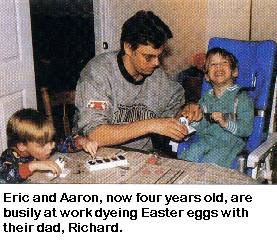
The boys at four now weigh in at around 30 pounds each. Aaron breathes through a tracheostomy tube and has some residual respiratory problems, but in all other ways he is like any other toddler, exploring and examining every new object as if it is some scientific breakthrough. Unable to vocalize, he makes all kinds of interesting creative noises and grins at his own cleverness.
Eric is certainly his own little person. Because of spastic quadriplegia cerebral palsy, he receives intensive therapy four times a week. He is unable to sit up or crawl, and even has trouble rolling over. His smile comes easily, however, and he is a happy boy. I can see the intelligence in his eyes.
The twins have strengthened us and they have taught us what is really important in life. When we had learned that Cindy was pregnant with twin boys, I had had dreams of big strapping football players: the first twins in the NFL! We would do so much together-run, bike, watch the games on Sundays. All these dreams disappeared when I had to face what I saw then as a grim truth.
Although things have calmed down a bit, we still have good days and bad days. More challenges lie ahead. But I wouldn't trade our boys for Super Bowl Twins! As I wrestle and play on the floor with them, many of the bad memories fade.
I look at them now and think back to that terrible summer night when Cindy went into premature labor. I realize how truly lucky we are to have these two special gifts. I know now that I do not have to give up all my dreams for the twins. I just let them create new ones. E P
Richard Bissell and his wife Cindy are nurses and work together at the Newton and Wellesley Alzheimer Center. They live with their twin sons, Eric and Aaron, in Grafton, Massachusetts.
