The Boston Globe Magazine
June 7, 1998
Mind and Body
/ By Richard SaltusHome, Sweet Hospital
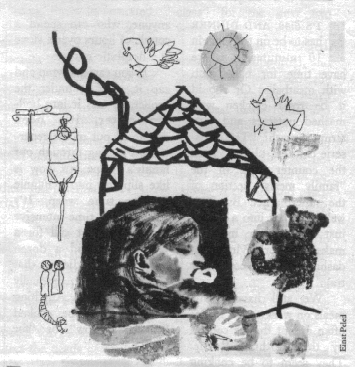
Although he needed tube feeding, constant oxygen, treatment for seizures, and round-the-clock attention, Scotty Luce spent the last six years of his short life at home.
Scotty’s parents, like an increasing number of parents today, took on the immense task of rendering hospital-like care at home -- aided by doctors, nurses, therapists, and others involved in the rapidly growing world of pediatric home care. Their reasons are similar to the one Scotty’s mother, Patricia Luce, gives: "He needed a home environment — it was important for him to have a mom, a dad, and a dog."
Scotty, who had a rare genetic condition that afflicted nearly every organ in his body, died in 1996. He made it only to age 12. He slept in a hospital bed and used a wheelchair; a line for nutrition led into his heart, and other tubes led to his stomach and intestines. He was cognitively impaired. Altogether, he was "medically fragile" — a description of infants and children so ill that they are living on the edge, and often only with high-tech life-support equipment.
As more and more infants survive extreme prematurity or illnesses that would have killed them in the past, families are facing the question of caring for them after the immediate crisis passes. "There’s a lot of high technology that didn’t exist in the past, and so I think as a result of that, we have a new breed of children that exist in the World today," says Patricia Luce, who lives in Worcester. She has founded an initiative called Family Partnerships, to assist families in pulling together the sometimes widely scattered resources needed for successful home care.
Until fairly recently, children with chronic, severe conditions requiring expert care and specialized equipment "remained in hospitals and institutions, because there was no support for families or financial support to have the child go home," says Dorothy Page, a family nurse practitioner who heads the pediatric homecare program of the University of Massachusetts Medical Center, in Worcester. She is also president of the National Association of Pediatric Home and Community Care, which she founded along with a UMass physician, Robert G. Zwerdling. The association is involved with education and research on home care of children and with setting standards.
The move toward bringing medically fragile children home stems in part from activist parents who pressed public agencies to help make home care possible. Federal Medicare and federal-state Medicaid reimbursement policies swung toward home care as new technologies and training of parents made it not only possible but cheaper for these children to stay at home. The newly available money, in turn, prompted a home-care industry that had already grown up around geriatric needs to diversify into pediatrics.
A broad range of medical conditions afflicts the infants and children who are being cared for at home. They include lung problems caused by prematurity or, sometimes, by the respiratory treatments for prematurity. Many of these children have tracheostomies — openings through the neck into the windpipe -- through which they are connected to ventilators. The tracheostomies need constant attention.
There are children with infections that demand long courses of intravenous antibiotics and young cancer patients on chemotherapy. Other children can’t eat, and they get all their nutrients through tubes. The care of such youngsters can be complex, demanding, and tiring, and the impact of the entire venture on the family is enormous.
"The stress and disruption of your life is indescribable," says Cynthia Bissell, mother of twin 4 1/2 year-old boys, Eric and Aaron, who were born 3 1/2 months premature and suffering multiple disabilities. Aaron had a tracheostomy and was on a ventilator until last summer to help him breathe.
"We live in a town house, and we had what was like a mini-NICU [neonatal intensive care unit] set up in our living room," Bissell says. "We had nurses, physical therapists, occupational therapists, speech therapists, caseworkers, coming in and out of the house all the time. There is no privacy."
Today, the twins attend a special-needs preschool. Eric, who has cerebral palsy, uses a wheelchair, and Aaron is receiving therapy for his speech, which was delayed because of the tracheostomy.
Even though Bissell and her husband are both nurses, she says they were initially intimidated by all the procedures they had to learn. "But you’d be amazed at how quickly parents become experts in their kids’ care," the Grafton mother says.
Like Luce and like other parents who make such a huge commitment, the Bissells believe the rewards of caring for medically fragile children at home are great. "We feel very strongly about this," says Bissell, who has founded a group called Families Organizing for Change that is funded primarily through the state Department of Mental Retardation. The group is aimed at generating support for families caring for children at home.
Besides DMR, other agencies involved in home care include the state Department of Public Health, Medicaid, the Massachusetts Commission on the Blind, and various private groups. Family Partnerships, in Worcester, can be reached at 508-756-7467. The National Association of Pediatric Home and Community Care, in Worcester, is at 508-856-1908.
A World Wide Web site established by Cynthia Bissell offers information about caring for children’ with tracheostomies. It is called Aaron’s Tracheostomy Page, and the address is www.tracheostomy.com.
To share an idea or to comment e-mail the author at Saltus@globe.com.
