
When a Child Truly Needs the Best
No, getting the right care at the right place isn't easy.
Yes, you can make it happen
By Sarah Baldauf
8/26/07

(Kevin Horan/Aurora for USN&WR) Heart
surgeon Charles Fraser with Rachel Parrish, 9, at Texas
Children's Hospital. He operated on Rachel in 1997, 1998, and
2001 to treat her for hypoplastic left heart syndrome.
Informed last summer that the only hope for their son's
Crohn's disease was to remove his colon, John and Brenda Ricci
made good on a vow. "We always said if it ever gets real serious
we would [switch] to Children's Hospital of Philadelphia," says
Brenda of the life-altering surgery prescribed for John Paul,
now almost 11, who was plagued by diarrhea and nasty side
effects from steroids he had to take.
Under the care of Robert Baldassano, director of chop's center for
pediatric inflammatory bowel disease, John Paul has gone from managing
an ostomy bag and dealing with blood clots and fatty liver deposits to
having his bowel reconnected and ditching the drugs. Earlier this
summer, he took to the waves with a boogie board at the Jersey shore.
"Just like any other kid," says his dad, his voice uneven.
Prior to Baldassano's management, John Paul had been treated at
another children's hospital in Philadelphia, about 45 minutes from the
family's Hamilton, N.J., home. But in the months following the ostomy to
rest his diseased bowel and large doses of steroids to reduce
inflammation, his condition worsened. His doctors consulted Baldassano
before cutting out the boy's colon.
Rather than endorsing their recommendation, Baldassano, a Crohn's
sufferer himself, thought it would be worth trying a different
combination of drugs and doses. Before long, John Paul was on the mend.
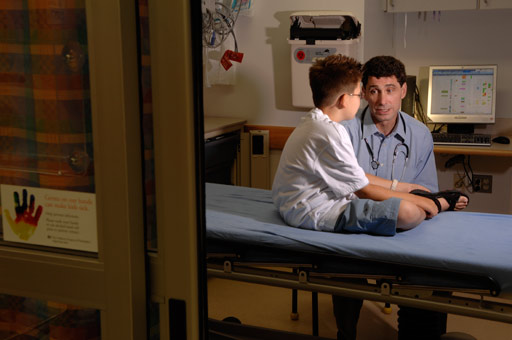
(SCOTT GOLDSMITH—AURORA FOR USN&WR) Robert Baldassano,
director, Center for Pediatric Inflammatory Bowel Disease, at Children's
Hospital of Philadelphia with 10-year-old John Paul Ricci, whose Crohn's
disease has been brought under control.
Virtual neighborhood. Dramatic as the Riccis'
experience may be, families with a very sick child don't always
end up in capable hands. Even good pediatricians can't be
expected to know about every expert like Charles Fraser, a Texas
Children's Hospital surgeon who can turn a malformed heart like
Rachel Parrish's into a sturdy pump.
There is a whole virtual neighborhood to scour, however. The
patient and parent groups that populate the Web are invaluable
resources, says
Stefanie Putkowski, a registered nurse and clinical information
specialist at the National Organization for Rare Disorders, a nonprofit
group in Danbury, Conn. She frequently fields calls from overwhelmed
parents who were just handed a rare diagnosis such as epidermolysis
bullosa, a group of genetic collagen disorders that cause severe
blistering; the "mild" type affects only about 1 in every 50,000 kids
born each year. Most of the time, Putkowski can steer them to an
appropriate patient group. Because of nord's familiarity with these
conditions, relationships with research centers, and scouring of
peer-reviewed journals, experts to contact can often be suggested. But
it's the patient groups—often run by families—that know the newest
information, the best experts, the most promising clinical trials.
Parents and other caregivers, after all, are the most motivated to
pour their hope and energy into the hunt. Aaron's Tracheostomy Page (www.tracheostomy.com)
is run by Cynthia Bissell, a registered nurse and mother of three
disabled children in Grafton, Mass. Aaron, a twin who is now 14, had
developed scar tissue in his airway as a premature newborn, related to
steps taken to support his lungs. After that, he needed a permanent hole
in his windpipe—a tracheostomy—to help him breathe. Bissell found no
online resources to help her manage her son's "trache" day to day, so
she launched the site. It has the information she was looking for, as
well as a medical glossary and links to other resources. And the site
hosts bustling message boards where participants boost one another's
spirits and ask for advice; parents recently debated two approaches to
trachea reconstruction. "It has been part of my therapy for the last 10
years," says Bissell.
It's obviously a good sign when the same experts' names keep coming
up in conversations and Web posts. But parents still should ask for data
and second opinions. "It does not offend me," says Donna Caniano,
surgeon in chief at Columbus Children's Hospital. "I think that's good
parenting."
Numbers. When any doctor provides a diagnosis or
proposes treatment, expert or otherwise, says Caniano, ask
whether the place recommended for care is the best choice and if
other experts should be consulted. These questions are just as
valid even before a child's birth if your pregnancy has been
identified as problematic, says Billie Lou Short, chief of
neonatology at Children's National Medical Center in Washington,
D.C. Not all neonatal ICUs are equal—there are three tiers—and a
high-risk newborn needs to be in a high-level NICU. (Level 3
NICUs are for the riskiest babies and are defined as 3a, 3b, and
3c; the smallest and sickest infants belong in a 3c facility.)
Ask the obstetrician where you should give birth, says Short.
"The important thing is to not be bashful." She has saved many a
newborn like Mi'Kal Gray—whose lungs were damaged during birth
when he inhaled fecal-contaminated amniotic fluid—by putting
them on an infant-adapted heart-lung bypass machine for a few
days or weeks to let their injured lungs or heart rest and gain
strength.

(JEFFREY MACMILLAN FOR USN&WR) Neonatologist Billie Short
with former patient Mi'kal Gray at Children's National Medical Center in
Washington, D.C. Mi'kal inhaled contaminated amniotic fluid at birth.
Numbers mean something, just as they do for adult conditions.
"It's very, very difficult to have high quality without high
volume," says Stephen Muething, a hospitalist and assistant vice president for patient
safety at Cincinnati Children's Hospital Medical Center. But nothing
should be assumed, he adds: "Volume is not the same as quality."
Understanding the definition of successful treatment is critical. In
juvenile rheumatoid arthritis, for example, the key is the percentage of
kids with complete joint function after a year of treatment. With a
sickle cell anemia treatment plan, it is the number of pain-free days.
Getting such stats out of hospital administrators or doctors' offices
can be difficult, says Muething, and there are no large databases
comparable to the one that covers Medicare patients.
Even when numbers are available in abundance—in pediatric oncology or
cystic fibrosis, say—they can only partially inform a decision of where
to seek treatment and from which doctor. "After all the data and all the
talking, it comes down to your gut"—and the family's needs and
limitations, says Muething. Many families can't or don't want to take a
child hundreds of miles from home.
These decisions, as Rana and William Meyers found, can generate heat.
Their daughter, Lily, 2, was born with erratic blood sugar and had
several seizures in her first few months of life. Medications controlled
her blood sugar, but the rambunctious toddler was becoming less willing
to sit for her thrice-daily shots.
Lily's doctors at Rady Children's Hospital-San Diego suspected
hyperinsulinism and urged her parents to get care at chop's congenital
hyperinsulinism center. If a small, defined part of Lily's pancreas was
the cause, it might be cut away, avoiding total removal of the organ or
the possibility of diabetes—and chop was the only center investigating a
radioactive dye that could make even a tiny area stand out in a pet
scan. Lily's meds were helping, argued some family members; why make her
a guinea pig? "We wanted to make her well," says her mother. The center
identified a minuscule offending portion, chop surgeon Scott Adzick
deftly plucked it out, and Lily, almost unbelievably, was cured.
A talk with an elite specialist might send an unexpected message:
Stay home. "Part of my job is to reassure people that they're getting
good care where they are," says Robin Cotton, director of
otolaryngology, head and neck surgery at Cincinnati Children's Hospital
Medical Center and a pre-eminent expert in disorders and in complex
pediatric airway reconstructions like the one he did on Malcolm Turner
with the help of a piece of the little boy's rib. If parents want to see
him but their child is being treated by someone he knows and trusts—in
particular, the 60 or so pediatric otolaryngologists he has trained—he
will vouch for their doctor.
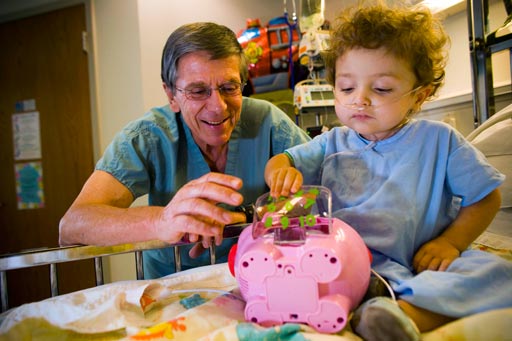
(JEFFREY MACMILLAN FOR USN&WR) Otolaryngologist Robin
Cotton of Cincinnati Children's Hospital Medical Center with patient
Malcolm Turner, whose airway Cotton rebuilt.
Besides, good specialists are in constant contact. Scans and lab
results fly across the country and oceans via E-mail, making it possible
for top practitioners to be consulted on tough cases. Cotton, Caniano,
and Baldassano field multiple inquiries every week.
Referral. If a face-to-face is necessary, the best way
to land a coveted appointment with a top-flight doctor is by
working the system through your child's current doctor. Parents
are welcome to call in themselves, says Baldassano, but their
kids are best served when a referral comes through another
doctor who sends medical records—or at least a summary
letter—and explains the case for urgency.
Thorough research is vital for families that must rely on a
nearby community hospital. It isn't that good pediatric medicine
is not regularly practiced in such places, says Caniano. "The issue is, if your
child has a problem with anesthesia or interoperatively, you have no
specialists." In a center like Columbus Children's, everyone, from the
pediatric nurses in the intensive care unit to the pharmacists,
psychologists, and board-certified pediatric surgeons and
anesthesiologists, focuses solely on children. As any pediatric expert
will tell you, says Caniano, "children are not little adults." The dose
of medicine for a 50-pound child is not a third of the dose for a
150-pound adult. Treatment protocols can be drastically different.
Caniano even argues that hospitalwide pediatric expertise is just as
important in routine procedures like tonsils removal, hernia repair, and
insertion of ear tubes because all require general anesthesia. If a
complication arises, she says, odds are that it will be recognized
immediately, and specialists are on hand.
That's a little extreme even for some at the upper rungs.
"Pediatricians tend to refer to pediatric hospitals, and family doctors
tend to refer to adult hospitals," says Cotton, and for routine
procedures that's fine with him. He believes most ear tube insertions
and basic sinus, adenoid, and tonsil surgeries are appropriately
performed by adult otolaryngologists if the child is otherwise healthy
and the surgeon and anesthesiologist have treated a good number of
children.
And even in the best children's hospitals, when parents do all the
right research, ask all the right questions, and advocate exhaustively
on their children's behalf, things can and do go very wrong. "We lost
faith in the system," says Ann Herzog of Wakefield, Mass. She and her
husband prepared for the arrival from Russia of their adopted daughter,
Yana, now 3, by seeking out the best place to repair her bladder
exstrophy, a condition in which the bladder develops outside the body.
Such infants are usually operated on right after birth, but that wasn't
an option where Yana was born. For such a complex case, and because she
was 2 years old, the Herzogs sought the best. They selected an East
Coast hospital that by all measures of data, research, and reputation
was one of a handful of top exstrophy centers.
That wasn't the case for Yana. After surgery, she had to be treated
at the Shriners Hospital for Children in Boston. She suffered
third-degree burns—the most severe kind—on her knees from friction while
in traction for days, her legs held straight and hips bent at a
90-degree angle. Yana's current exstrophy team at Johns Hopkins Hospital
in Baltimore noted in a letter to Yana's pediatrician (who is not a part
of the hospital system where the injury occurred) that Hopkins never
uses such an approach following surgery.
How did this happen? The Herzogs took copious notes throughout Yana's
hospital stay, questioned her caregivers, and repeatedly called
attention to her traction wounds. What most haunts Herzog is that Yana's
surgeon went on vacation for over a week two days after her major
surgery. Yana has proved amazingly resilient and is an active
preschooler, but Herzog and her husband still grapple with anger and
guilt. "You want to believe the medical team is doing the best they
can," she says, but parents' participation is still critical. "Don't be
afraid to speak up," she cautions, or to remove your child if things go
wrong.
Sheer emotional exhaustion can inhibit the most well-intentioned
parents. Resources outside the hospital often do exist, but digging them
up (or enlisting a friend or family member with more energy) is the
trick, says Putkowski of nord. Most major pharmaceutical companies, for
example, offer breaks on the cost of expensive prescription drugs, even
if a child is insured. Local pharmacists should know about such
assistance programs.
"Annoyance campaign." Tackling insurance companies to
ok out-of-network care and unapproved treatments is another
hurdle well worth the challenge. "We encourage people to take on
their insurance companies," says Putkowski, who worked for one
and says there is more leeway than parents may think. nord
offers template letters to launch the appeals process—including
one for filing a formal complaint with the state insurance
commission. The push to get coverage, she says, is a
letter-writing, telephone, and E-mail "annoyance campaign."
It's one that can succeed with public programs, too. Kim
Arnold, a Dallas mother of premature triplets now 4 years old,
has tolled uncountable hours, many of them spent weeping in
frustration, in the local Medicaid office. With guidance from
other parents and from social workers in her sons' doctors'
offices, the Arnolds persisted and got a precious waiver of
existing rules to cover the nonstop trips to the hospital and
appointments with specialists for Nate, one of the boys.
Her advice to parents struggling under the weight of bureaucracy and
medical bills is simple: "Don't give up."
Help can come from unexpected sources. Single father Joe Vettori was
able to seek a neurology consultation at Children's Hospital Boston for
4-year-old Kaylee, born with agenesis of the corpus callosum (the
fibrous band between the two halves of her brain hadn't developed),
because the two flew free from a small airport near their home in Lima,
Ohio. All it took was his word that otherwise the travel would be
unaffordable, and the National Patient Travel Center arranged an "Angel
Flight." "I never thought such a thing existed," says Vettori. Kaylee's
grandmother found the service—through a patient group.
Where to Turn. When children need help, those who care
for them can get some from resources like these.
National Organization for Rare
Disorders. A rich (and free) source of information on
treatments, patient groups, and financial services; has reports
reviewed by experts on unusual conditions.
National Patient Travel Center. Arranges free or discounted
air travel through commercial carriers and private plane owners.
Parent to Parent USA. State-by-state organizations pair you with an
appropriate mentor family; groups often host relevant workshops like
"How to handle the Medicaid waiver program."
American Pediatric Surgical Association. Parents/families section
explains conditions and procedures; search function helps find APSA
surgeons.
American Academy of Pediatrics. Provides a referral service for
pediatricians and specialists; fact sheets explain subspecialists'
roles; search by topic function.
|